Note
This post was written by converting the PPT of an internal seminar presentation from a school club using an LLM.
Introduction
In March 2026, Google’s Threat Intelligence Group (GTIG) disclosed multiple zero-day iOS exploit chains used by threat actors believed to be state-sponsored. Since at least November 2025, these exploits had been deployed across separate campaigns targeting Saudi Arabia, Turkey, Malaysia, and Ukraine.
This post analyzes one of them — the Safari full chain known as DarkSword. Its impact is simple, but devastating.
Simply visiting a specific link is enough to fully compromise an iPhone.
The full chain is composed of six distinct vulnerabilities, and this post walks through the Root Cause Analysis (RCA) and exploitation of each one.
Background: Safari’s Multi-Process Architecture
Safari (WebKit) is not a single monolithic process; it is composed of multiple processes separated by role. Each process runs at a different privilege level and is isolated inside a Sandbox.
- Renderer Process (WebContent) — Handles HTML/JS/CSS rendering. The weakest-privileged (Sandboxed) process.
- Privileged Process — A medium-privileged (Sandboxed) process granted some capabilities for a specific purpose (GPU, Network, etc.).
- OS Process / Kernel — The strongly-privileged region outside the Safari Sandbox boundary.
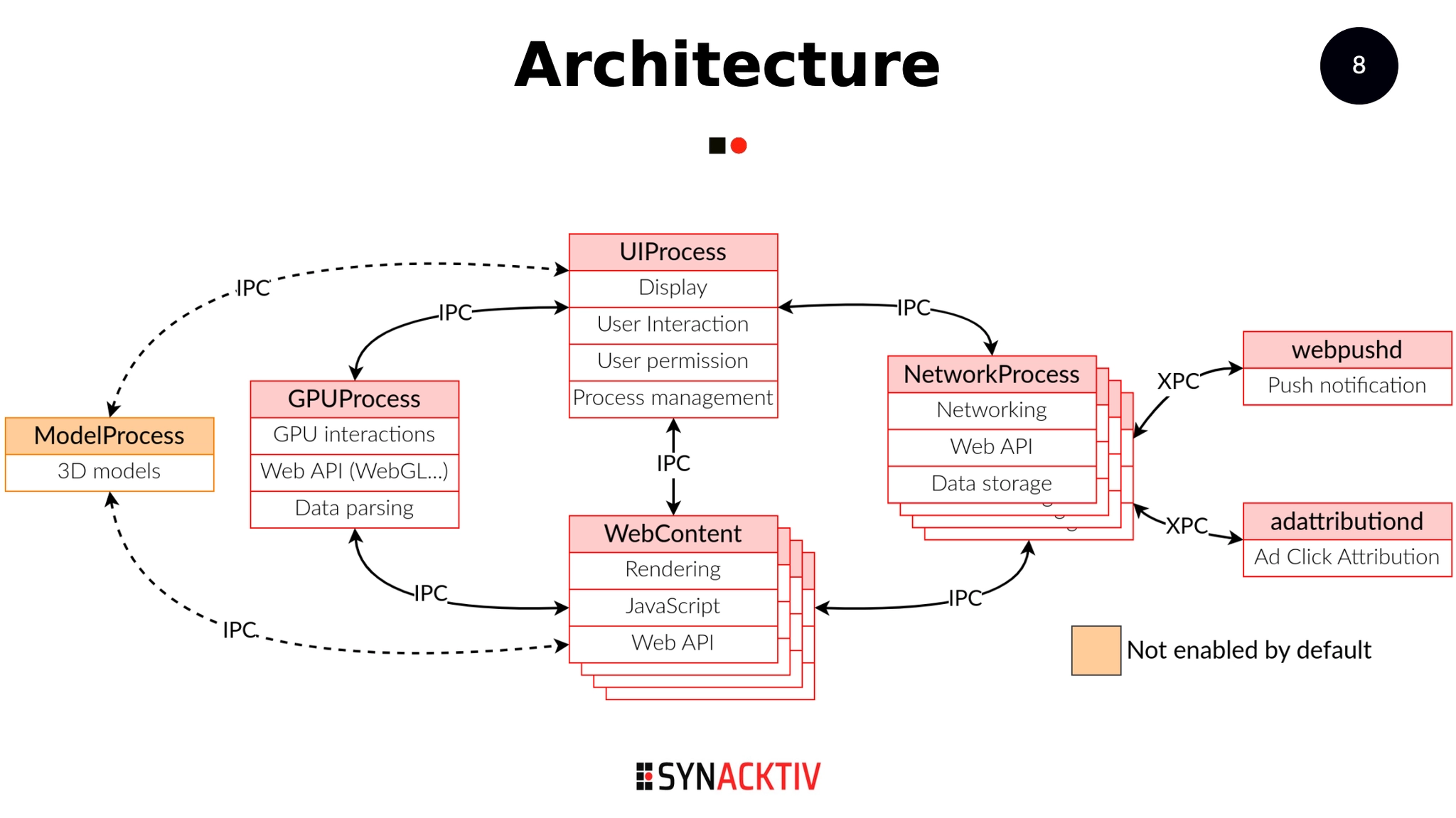
The processes are isolated from one another and communicate only through IPC built on Mach XPC. This structure is exactly what determines the difficulty of an attack.
- Even after obtaining an RCE primitive in the Renderer process, the Sandbox limits you to restricted privileges.
- Therefore, you must use the Renderer’s privileges to obtain another RCE primitive in a different process (Sandbox Escape).
- In other words, an RCE primitive inside Safari alone does not equal full iOS RCE. Only after completing the Sandbox Escape do you finally break out of every Sandbox.
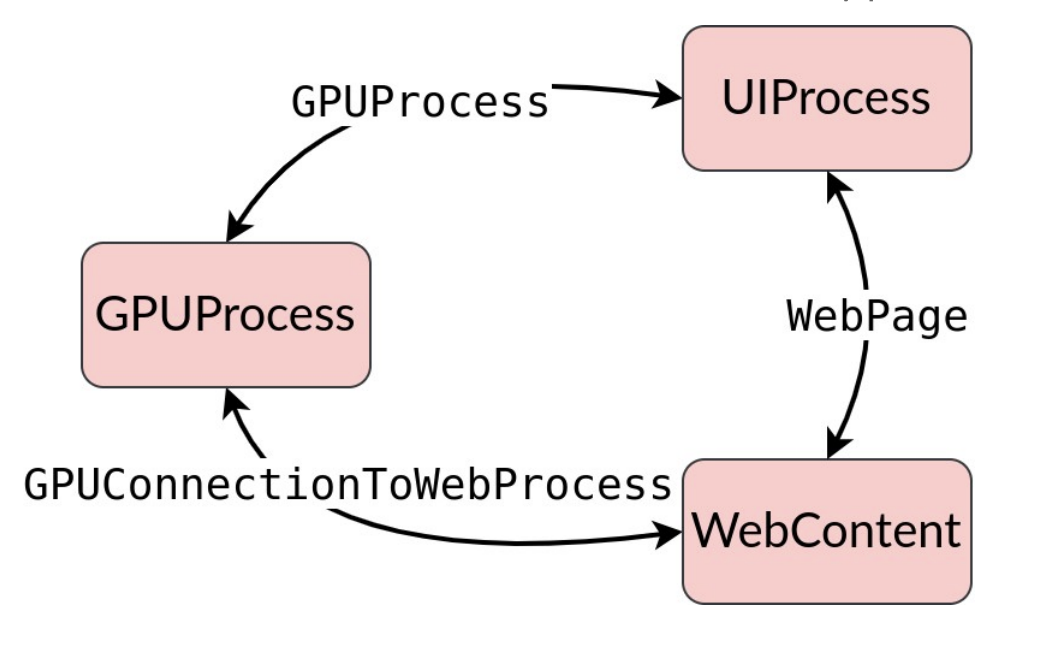
Exploit Chain Overview
The DarkSword chain flows through renderer compromise → mitigation bypass → sandbox escape → GPU escape → kernel privilege escalation, weaving six vulnerabilities together.
| Stage | Role | CVE |
|---|---|---|
| ① Renderer RCE | JavaScriptCore exploit | CVE-2025-31277 / CVE-2025-43529 |
| ② PAC Bypass | Pointer authentication bypass | CVE-2026-20700 |
| ③ Renderer SBX | Renderer sandbox escape | CVE-2025-14174 |
| ④ GPU SBX | GPU process sandbox escape | CVE-2025-43510 |
| ⑤ LPE | Kernel privilege escalation | CVE-2025-43520 |
Starting from two JavaScriptCore RCEs (CVE-2025-31277 / CVE-2025-43529), the chain links PAC Bypass → Renderer SBX → GPU SBX → LPE in sequence.
Exploit #1 — Renderer Exploit (JavaScriptCore)
The chain begins with RCE in the JavaScript engine, JavaScriptCore (JSC). The talk covers two vulnerabilities.
- CVE-2025-31277 — JavaScriptCore JIT Type Confusion (patched in iOS 18.6)
- CVE-2025-43529 — JavaScriptCore JIT DFG GC Bug to UAF (patched in iOS 18.7.3, 26.2)
This post focuses on CVE-2025-43529, which is the more interesting of the two because it is deeply entangled with how the GC works. In one line:
A Use-After-Free caused by a missing StoreBarrier insertion for Upsilon nodes in the DFG JIT’s
StoreBarrierInsertionPhase.
Background — JIT & GC
Two pieces of prerequisite knowledge are needed to understand this bug.
- JIT (Just-In-Time) Compiler — Translates bytecode into machine code at runtime to boost execution speed.
- GC (Garbage Collection) — JavaScript allocates and frees objects automatically, releasing an object once it is no longer used.
Generational GC
JSC uses a Generational GC that partitions memory based on the age of objects.
- Memory is divided into new space (Eden) and old space.
- Every object starts in Eden; when Eden fills up, an Eden GC runs. → Surviving objects are promoted to old space.
- Cleanup of old-space objects is done through a full GC.
Here a crucial exception arises.
Exception: If an Old object points to an Eden object, an Eden-only scan cannot discover that reference.
From the perspective of a lightweight GC that only scans Eden, an object in old space referencing an Eden object goes unnoticed — so it may judge the Eden object as “used by no one” and free it. When that happens, the old object is left holding a dangling pointer to already-freed memory.
StoreBarrier
The mechanism that prevents this is the StoreBarrier. The moment a new old→eden reference is created, it tells the GC “please remember this reference,” storing it in the remembered set. Because the Eden GC also checks the remembered set, an Eden object referenced by an old object is never mistakenly freed.
cellState — Tri-color Marking
To drive the Generational GC, every object encodes its state through a 1-byte cellState (a color tag).
- White(1) — An object freshly allocated in Eden. If it stays unmarked through a GC cycle, it is collected.
- Black(0) — An object whose marking is complete or in progress. Treated as a live object.
- Grey(2) — An object that needs scanning. Its references have changed, so a GC scan is required.
Core rule: A Black object must not point to a White object.
The GC assumes a Black object “needs no scanning” and does not inspect the White objects it points to. → As a result, a White object that is still alive can end up freed.
Concurrent GC
On top of this comes the Concurrent GC. While the application runs, a background GC Thread reclaims memory (marking) concurrently with the Main Thread. Because marking and application code run in parallel, there is a dangerous window in which a new White reference gets attached to an already-marked (Black) object. The StoreBarrier defends precisely this moment — by coloring the referenced object Grey and storing it in the remembered set.
Visually, it looks like this. Without a StoreBarrier, Obj1st in Old Space points to the still-alive Eden object Obj2nd, yet the GC (the garbage truck) collects Obj2nd without knowing.
A Black object points to a White object, but the GC does not inspect it — so the live White object (Obj2nd) is freed, producing a Use-After-Free.
When the StoreBarrier works correctly, the moment an old→eden reference is created it colors the target Grey — signaling “I’m still using this, please remember it” to the Marking Thread — and stores it in the remembered set.
Once the StoreBarrier marks Obj2nd Grey and registers it in the remembered set, the GC recognizes the object as alive and does not collect it.
In short, only when the StoreBarrier is inserted correctly is an old→eden (or Black→White) reference safely remembered by the GC. The essence of this bug is that this barrier goes missing.
Background — The Three Tiers of DFG JIT
JSC’s JIT consists of three tiers in total.
- Tier 1: Baseline JIT — Generates native code quickly with low compilation overhead.
- Tier 2: DFG JIT — Serious optimization begins after Baseline. Uses collected type information to speculate and eliminate unnecessary operations.
- Tier 3: FTL JIT — Top-tier optimization.
The bug occurs during optimization in Tier 2, the DFG JIT.
The Bug — The Vanished StoreBarrier
During DFG optimization, the StoreBarrierInsertionPhase is responsible for inserting a StoreBarrier after write nodes such as PutByOffset. In this vulnerability, however, the StoreBarrier that should be inserted is not inserted.
The heart of the problem lies in the DFG IR’s Phi / Upsilon nodes.
- Upsilon node — A node that marks, in each basic block (BB), the value to be used by a Phi.
- Phi node — A node that selects one of several value definitions at a control-flow merge point. The final value is determined by which BB execution arrived from.
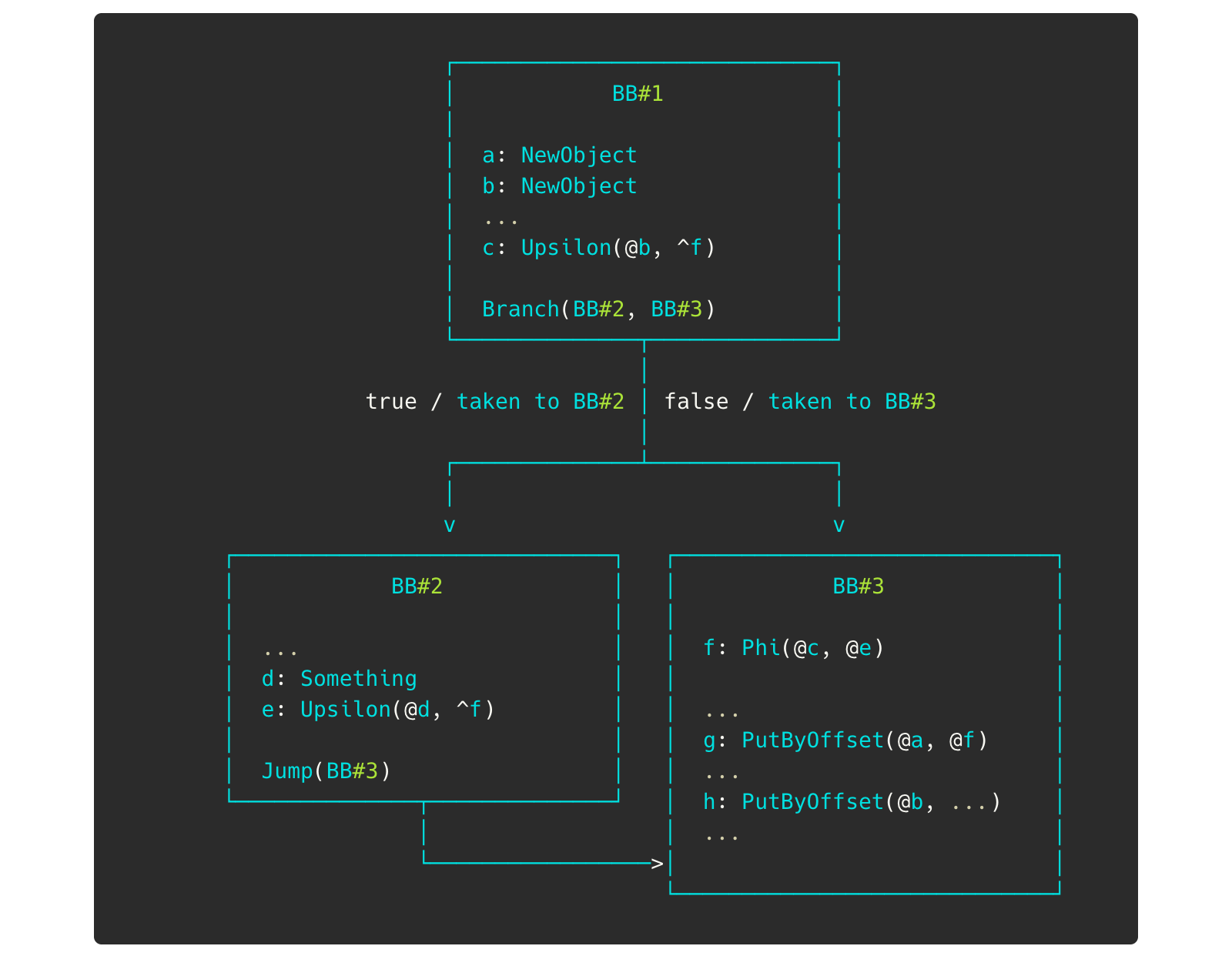
Walking through the code flow:
A.p0can beb, andb.p0can bea, forming the graphA -> b -> a. That is, ifAis a live object, thenbandamust be alive too.- In the first
PutByOffset -> A.p0 = f, the old-space objectAcomes to point to the new objectf. Sincefis reachable throughA****, a StoreBarrier must be inserted. - But
fis a Phi node. Meaning thatbandd— connected via Upsilon and eligible to becomef— are effectively stored intoAas well.
And this is exactly where the bug detonates.
Bug: The objects of Upsilon nodes connected to a Phi node are not handled.
The Phi itself has a StoreBarrier, but
banddconnected through the Phi are marked as objects the GC needn’t scan, so StoreBarrier insertion is skipped. → The GC has no idea thatbordpoint toa.
This leads to a Use-After-Free through the following scenario:
- The Marking thread marks
Aandbas Black. - The Main thread executes
b.p0 = a. At this pointais a not-yet-marked Eden object, so it is White. - Because there is no StoreBarrier, the GC does not know
bpoints toa. → It judgesato have no other referencing path and frees it. - Later, reading
b.p0accesses the freeda, triggering a Use-After-Free.
Building an arbitrary read/write primitive inside JSC on top of this UAF completes RCE within the renderer process.
Exploit #2 — PAC Bypass (CVE-2026-20700)
Code execution inside the renderer is now possible, but Apple’s powerful mitigation PAC (Pointer Authentication Code) blocks arbitrary code execution. The next piece of the chain is bypassing this PAC.
An attacker holding an AAR/AAW (arbitrary read/write) primitive tampers with transient loader state on the stack, hijacking dyld’s notify path to bypass PAC verification.
Background — PAC
PAC is a mitigation introduced to prevent an attacker from arbitrarily modifying pointers.
- It embeds an encrypted signature into the unused upper bits of a pointer.
- It then verifies the signature when the pointer is later used.
- Apple uses an ARM PAC implementation + a custom version. Usermode PAC is performed in dyld, Kernelmode PAC in the Kernel.
Since an attacker cannot generate a valid signature even after tampering with a pointer to an arbitrary address, arbitrary code execution is blocked. The attacker’s goal is therefore:
PAC Bypass: an exploit that forges a pointer to appear legitimately signed in order to execute arbitrary code.
Background — dyld & Loader*
Apple manages shared libraries requiring dynamic linking through dyld (dynamic linker/loader) — a role similar to Linux’s PLT/GOT. dyld loads shared libraries into memory at the binary’s entry point and then links them, performing PAC signing during this process.
The flow of a runtime library load (dlopen) is as follows:
- Load the requested library into memory.
- Manage the library as a
Loader*object (containing the library path, dependencies, initializer function addresses, etc.). - Call the library’s constructor functions.
- Signal load completion via the Notifier.
The key insight here is this:
What if the
Loader*object is forged? → A valid PAC signature can be produced.
Background — Protection Mechanisms
Apple is aware of this risk too, so dyld keeps its internal control data locked read-only and unlocks it only when needed. There are two write mechanisms.
withWritableMemory([&]{…})— Internal control data can be written only inside the lambda.withLoadersWriteLockAndProtectedStack([&]{…})— Takes a Lock when changing Loader state and executes code inside a protected stack.
dyld also uses two approaches when creating temporary buffers.
STACK_ALLOC_VECTOR(TYPE, NAME, QUANTITY)— Creates a fixed-size buffer on top of the current function’s stack frame. Fast, but destroyed together with the stack frame.persistentAllocator— Allocates memory from dyld’s managed heap. Survives even after the stack frame is destroyed.
The Bug — Filled in the Protected Stack, Consumed in the Normal Stack
While loading a shared library, dyld allocates the Loader object on the normal stack, then fills it inside the protected region. The problem is that an attacker holding an AAW/AAR primitive can tamper — through the normal stack — with the data that was filled inside the protected region.
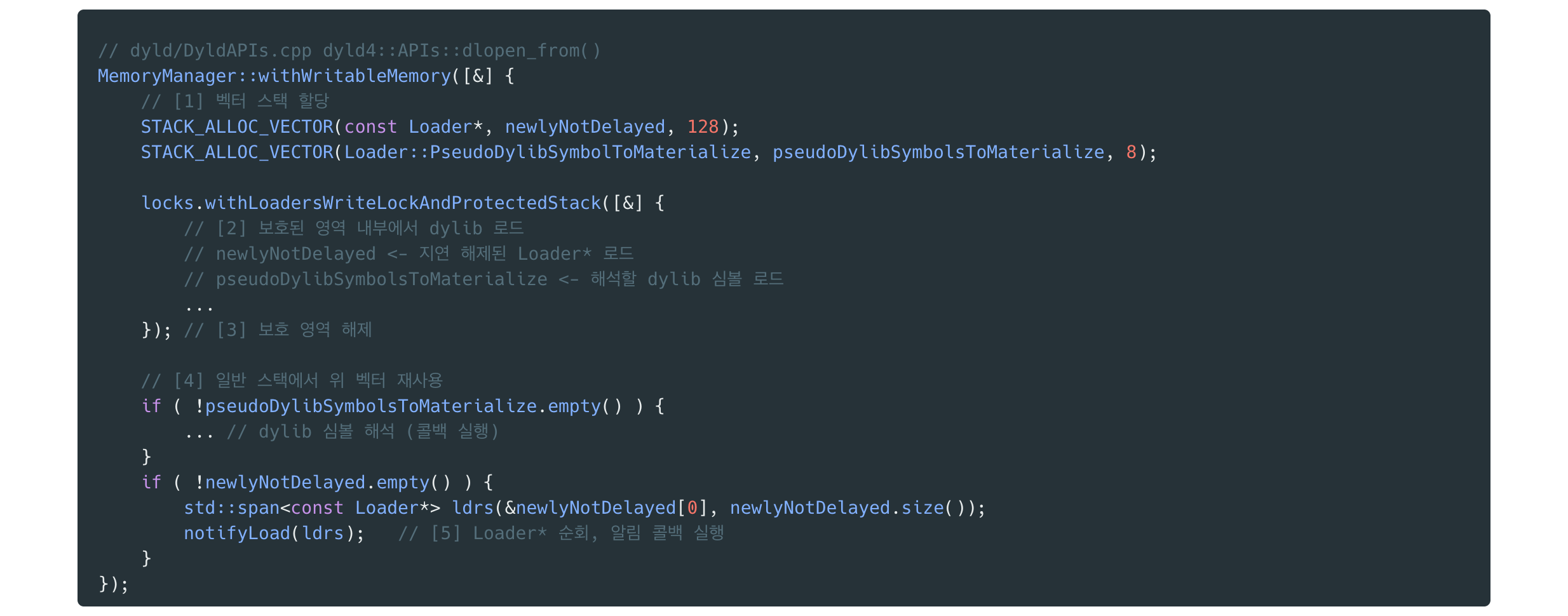
The data filled inside the protected region is newlyNotDelayed and pseudoDylibSymbolsToMaterialize; the symbol data within is filled with real addresses (PAC-signed pointers). The attacker targets the following gap.
In the window after the protected region but just before the data is consumed, rewriting the vector contents to a
Loaderobject of the attacker’s choosing lets them produce an arbitrarily forged pointer that already carries a valid PAC signature.
That is, just before a legitimately signed Loader* is consumed by notifyLoad, the attacker swaps its value, passing off their desired forged pointer as “legitimately signed.” PAC is thereby bypassed, opening the path to arbitrary code execution.
Exploit #3 — Renderer Sandbox Escape (CVE-2025-14174)
Reliable code execution inside the renderer is now possible. But as seen earlier, the renderer is trapped in a strong sandbox. The next goal is to escape the renderer sandbox.
An out-of-bounds write that arises when ANGLE performs a write larger than the allocated buffer during 3D texture rendering.
Background — Sandbox
Apple’s Sandbox is a mitigation that restricts a process to accessing only the resources it actually needs.
- It is handled by the kernel module
Sandbox.kext. - It is driven by profiles written in SBPL (Sandbox Profile Language), a Scheme-based language.
- It defines allow or deny decisions for each requested operation.
Safari has a sandbox profile for each process. Because we compromised the renderer earlier, we are bound by the renderer’s sandbox constraints. Escaping it requires touching code in a more privileged process (GPUProcess).
Background — WebGL & ANGLE
- WebGL — A JavaScript API that enables hardware-accelerated 2D/3D graphics rendering in the browser.
- ANGLE (Almost Native Graphics Layer Engine) — A WebGL ↔︎ native command translator. It forwards received WebGL commands to each platform’s graphics backend. On macOS, the graphics backend is Metal.
The important point here is that WebGL is GPUProcess-side code (the WebGPU subsystem) callable across the renderer sandbox boundary. In other words, the renderer can execute GPU-process code through WebGL calls — and if that code has a bug, the sandbox boundary can be crossed.
Background — Texture Upload
To hand an image to the GPU, the browser prepares pixel data in JavaScript, and the graphics stack copies it into a form the GPU can read. Here, glPixelStorei() configures how the source data should be read from memory. The bug-relevant fields are:
pixelsRowPitch— The number of bytes one row of pixels occupies in memory.pixelsDepthPitch— The number of bytes per layer (pixelsRowPitch × GL_UNPACK_IMAGE_HEIGHT).GL_UNPACK_IMAGE_HEIGHT— The height of one image layer in a 3D or array texture (attacker-controllable).
The Bug — Allocation Size ≠ Write Size
ANGLE uses a depth texture in 3D textures to represent the distance from each pixel to the camera. To clamp the depth texture into a valid range, Metal creates a temporary buffer and passes it to the SaturateDepth function. It is precisely in this process that the allocated buffer size and the actual write size differ, producing an OOB.
- Allocation size:
pixelsDepthPitch = pixelsRowPitch × GL_UNPACK_IMAGE_HEIGHT(attacker-controlled height) - Write size:
pixelsRowPitch × mtlArea.size.height(actual image height)
By making GL_UNPACK_IMAGE_HEIGHT smaller than the actual image height, the attacker can allocate a buffer smaller than truly needed. As a result, the write exceeds the allocation — a classic OOB write.
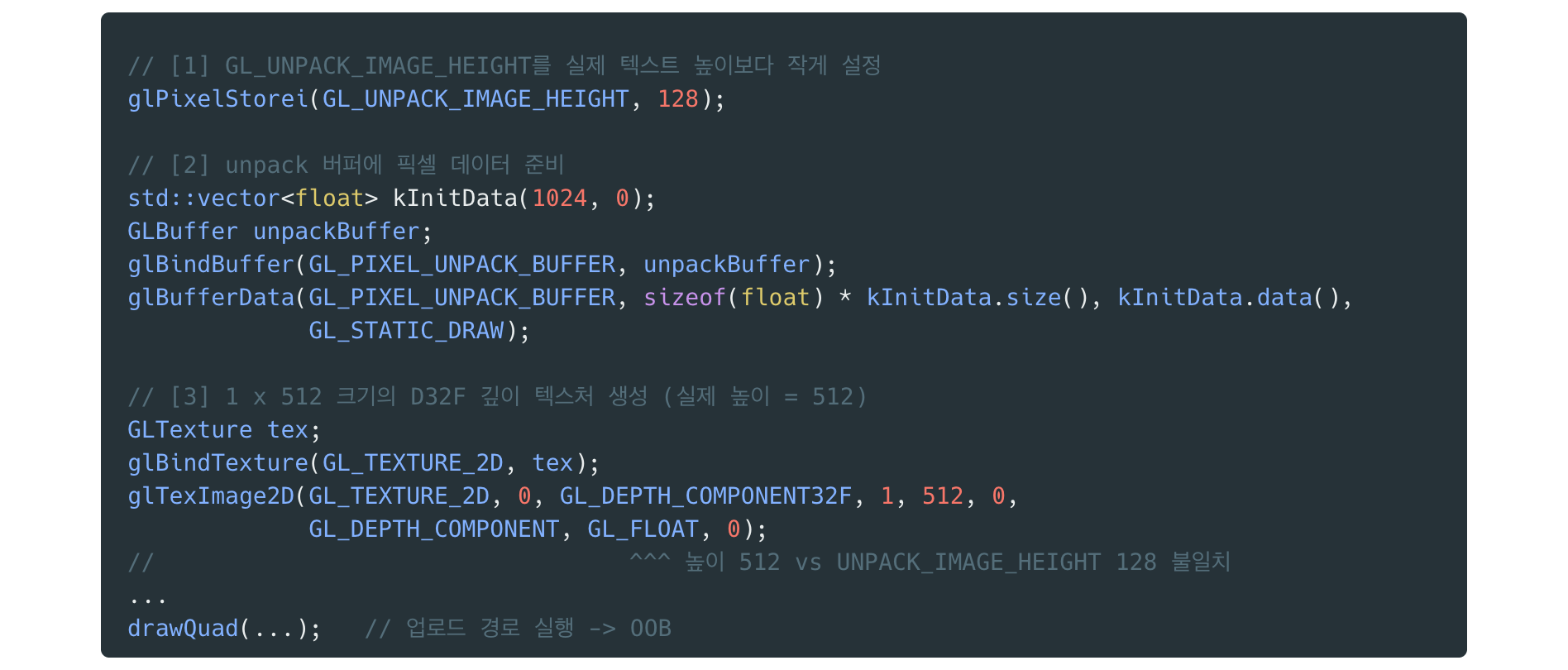
The core logic, expressed in code:
// [1] Set GL_UNPACK_IMAGE_HEIGHT smaller than the actual texture heightglPixelStorei(GL_UNPACK_IMAGE_HEIGHT, 128);
// [2] Prepare pixel data in the unpack bufferstd::vector<float> kInitData(1024, 0);GLBuffer unpackBuffer;glBindBuffer(GL_PIXEL_UNPACK_BUFFER, unpackBuffer);glBufferData(GL_PIXEL_UNPACK_BUFFER, sizeof(float) * kInitData.size(), kInitData.data(), GL_STATIC_DRAW);
// [3] Create a 1 x 512 D32F depth texture (actual height = 512)GLTexture tex;glBindTexture(GL_TEXTURE_2D, tex);glTexImage2D(GL_TEXTURE_2D, 0, GL_DEPTH_COMPONENT32F, 1, 512, 0, GL_DEPTH_COMPONENT, GL_FLOAT, 0);// ^^^ height 512 vs UNPACK_IMAGE_HEIGHT 128 mismatch...drawQuad(...); // Execute the upload path -> OOBBecause this OOB write lands on the GPUProcess heap, it lets the attacker pivot control into the GPU process and thereby escape the renderer sandbox.
Exploit #4 — GPU Sandbox Escape (CVE-2025-43510)
The renderer sandbox is behind us, but now the GPUProcess sandbox remains. The next vulnerability targets a race condition in a GPU driver.
AppleM2ScalerCSCDriverfails to take a lock during the COW (Copy-on-Write) process, producing a TOCTOU on shared memory.
Background — Mach VM
vm_object— An array of physical pages.vm_map_entry— Represents which virtual-address range in a process’s address space views whichvm_object.- When several
vm_map_entryobjects point to a singlevm_object, it becomes shared memory.
Background — Copy on Write
COW is a memory-optimization technique where, when multiple processes share a single page, the page is copied first and only then written to at the moment of a write.
- When two processes share memory, the same physical page (read-only) is allocated instead of a copy.
- When either side then attempts a write, a Page Fault occurs.
- The kernel creates a copy and updates that process’s PTE.
- From then on, each writes to its own separated page.
This process must always be protected by a Lock.
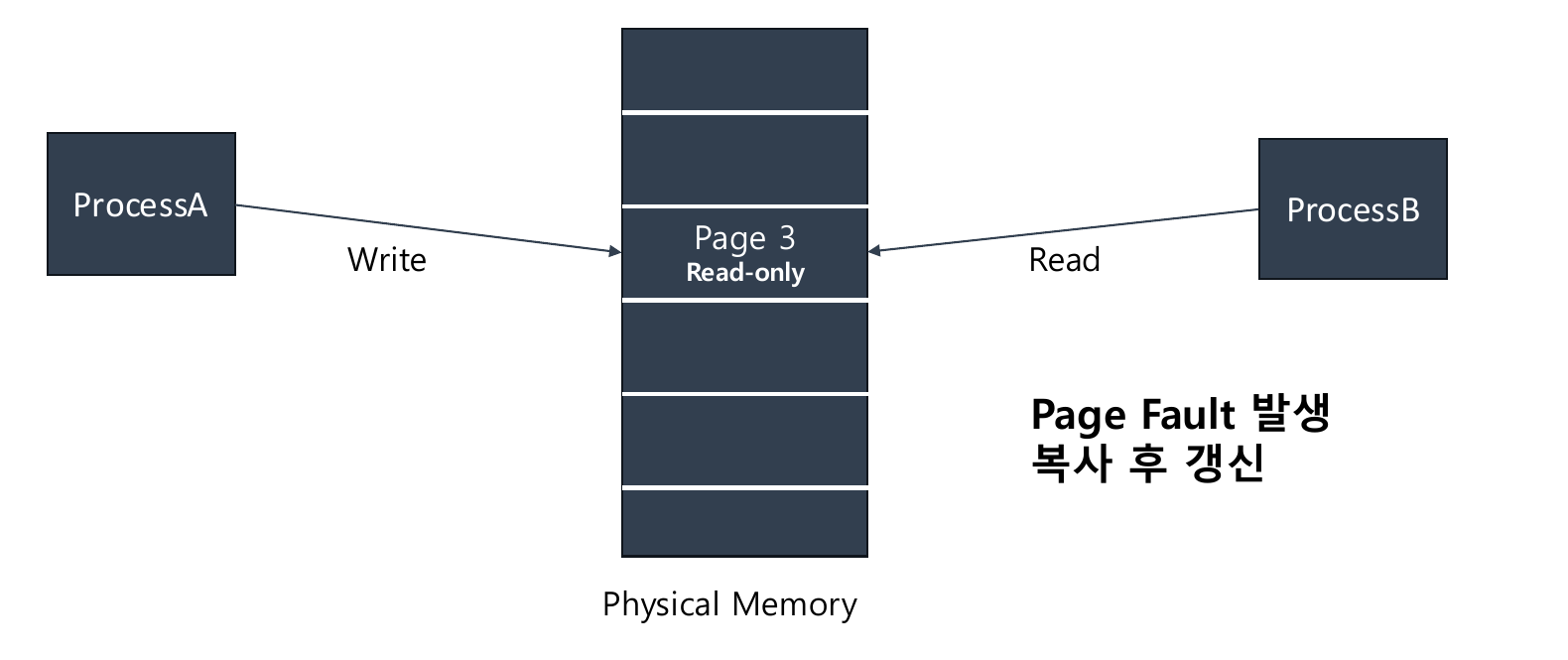
The COW behavior, step by step:
① Two processes share a single physical page as read-only.
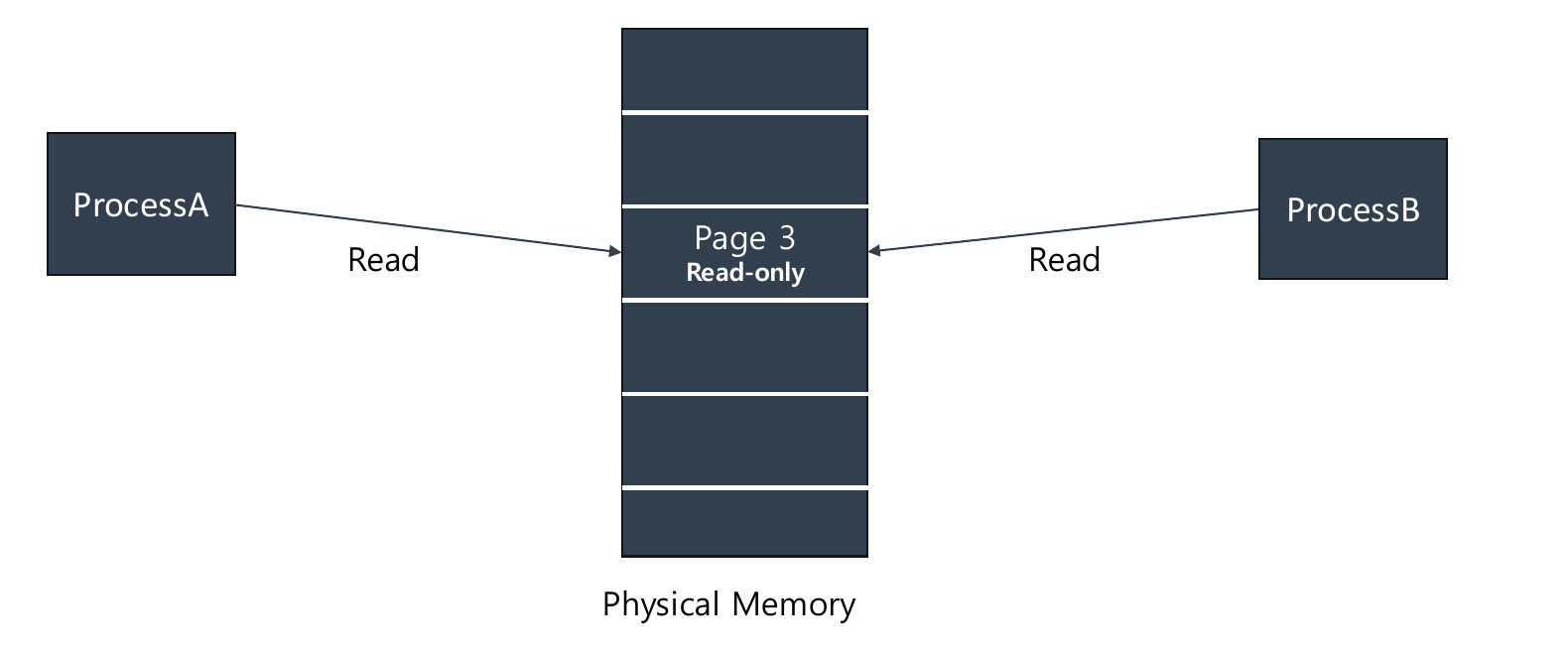
② When ProcessA attempts a write, a Page Fault occurs.
③ The kernel copies the page (R/W), updates the PTE, and only then performs the write.
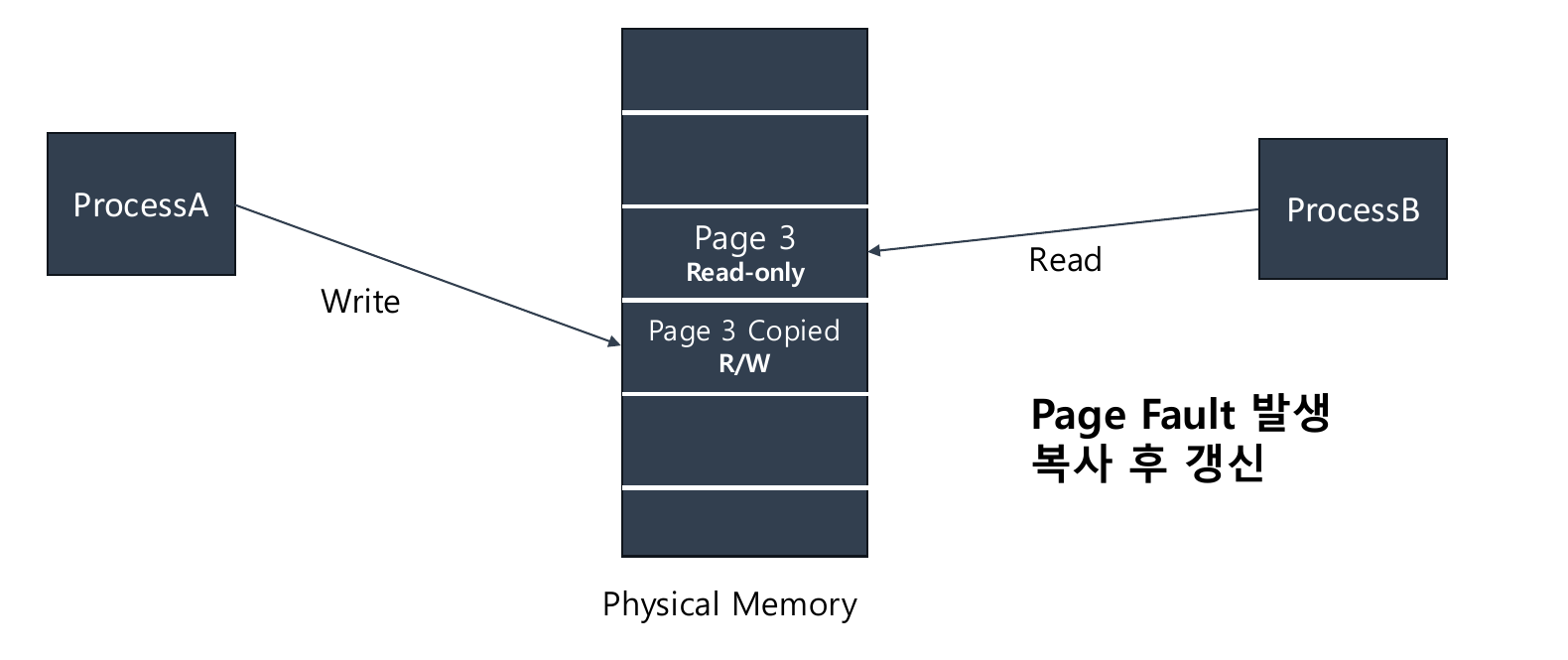
Without the lock, an attacker can write to the original page — not the copy — via a TOCTOU before the COW page is separated.
The Bug
AppleM2ScalerCSCDriver’s selector 1 handler checks the COW state without a lock, then trusts that result and proceeds with the write.
A TOCTOU is established the moment mach_vm_copy slips into the gap between this “check (Time-of-Check)” and “write (Time-of-Use).”
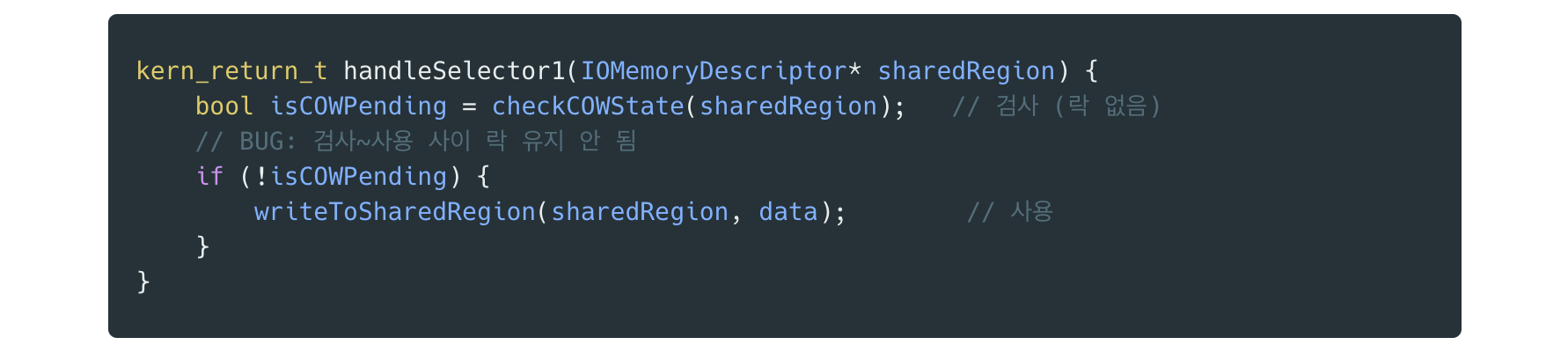
Exploitation
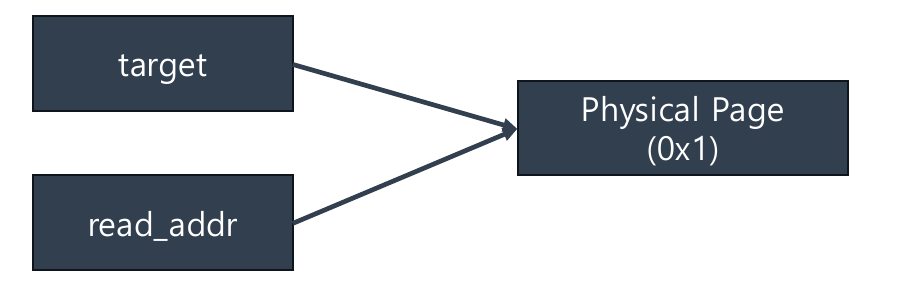
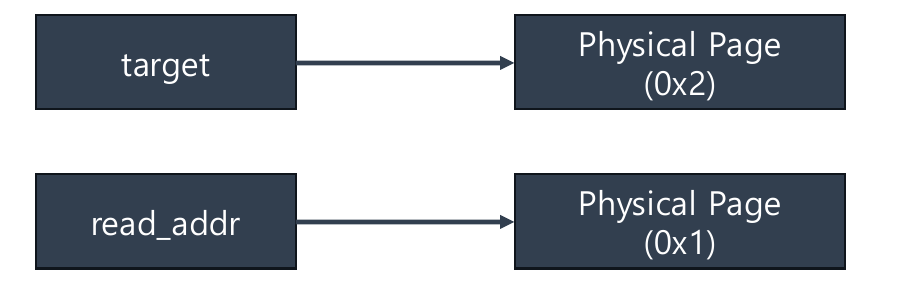
The exploit uses mach_vm_copy to artificially manipulate COW state and win the race. The step-by-step state transitions:
① In mach_vm_copy****, make target and read_addr (the copy source) identical. Since this is a read, both reference the same read-only physical page (0x1).
② Writing through the vulnerable handler (selector 1) separates the page. target splits off to a new copy page (0x2), while read_addr stays on the original (0x1).
③ Calling mach_vm_copy again reverts the copied page to read-only. From this state, ② is repeated.
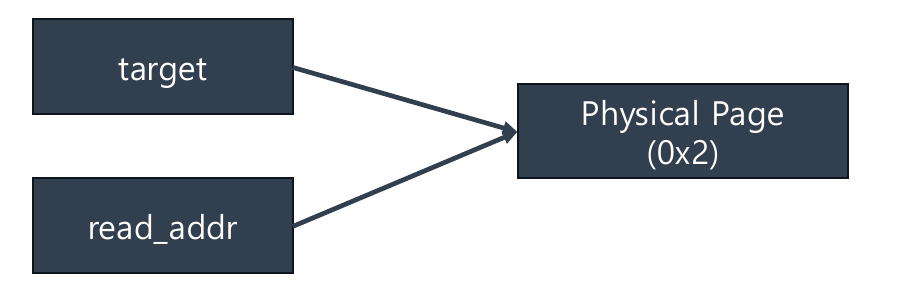
The key is to wedge mach_vm_copy into the “COW-state check → write” gap of ②. Normally the page is separated and the write lands on the copy, but if the check overlaps in time with the mach_vm_copy execution, the write is performed on the unseparated original COW page. The instant this race succeeds, the attacker can modify even an immutable (read-only) page through physical memory.
- In this exploit, the target is set to an OOL (Out-Of-Line) buffer page.
- After sending an OOL message to
mediaplaybackd(reachable from the GPUProcess), the attacker rewrites that daemon’smalloc_zones(which stores function pointers formalloc,calloc,free, etc.) to an attacker-controlled zone. - Subsequently, when the daemon calls
malloc, the attacker-controlled function pointer is executed.
This crosses the GPU-process sandbox to gain code execution in a higher-privileged daemon.
Exploit #5 — Local Privilege Escalation (CVE-2025-43520)
The final piece of the chain is kernel privilege escalation. Apple’s advisory describes this bug merely as a “memory corruption issue,” but dissecting the actual DarkSword exploit (darksword-kexploit) reveals the root cause to be a TOCTOU in XNU’s VFS cluster I/O path (bsd/vfs/vfs_cluster.c).
cluster_read_ext/cluster_write_extverify the physical contiguity of the user buffer at two different points in time. If the attacker remaps the virtual-address range in between, the kernel performs a contiguous copy based on the wrong physical page, producing an OOB R/W against physical memory.
Note
This post will be updated